
Why Difficult Conversations Feel So Hard
Most of us have a conversation we’ve been putting off. Perhaps there’s something at work that isn’t working; a friendship that’s become one-sided, a situation at home that needs to be addressed but we’re ducking. We know we need to say something, but the thought of actually saying it feels too much. Not only our own stress and anxiety, but also the worry about how the other person is going to react.
Or perhaps it’s a “discussion” you’re having regularly but it always goes the same way – exasperation, misunderstandings, rages, or sulks. Nothing’s changing.
When two people talk, there is more going on than just the words, and there’s some useful frameworks for gaining understanding along with some practical, evidence-based approaches that can genuinely shift how those conversations go.
Here, I’m going to introduce one of these frameworks which I find really useful – the Ego States from the field of Transactional Analysis – and then provide a set of practical tools you can take into real conversations.
What I love about this is that it’s one of the few areas where we genuinely can influence how someone else behaves. We often hear that we can’t control other people’s reactions, only our own. And of course, that’s true. But how we show up in a conversation does impact what the other person is likely to do next. We are in a transaction with each other – a dance essentially – and the moves we make influence the moves someone responds with. Understanding this is reassuring and pretty empowering.
Introducing the Ego States – The 3 Parts of a Conversation
Transactional Analysis (TA) is a framework developed by psychiatrist Eric Berne in the late 1950s. At its heart is the idea that, in any interaction, we are operating from one of three inner states – the ego states of Parent, Adult and Child.
Each of these ego states makes us act and think in certain ways that influence how we interact with others.
The Parent
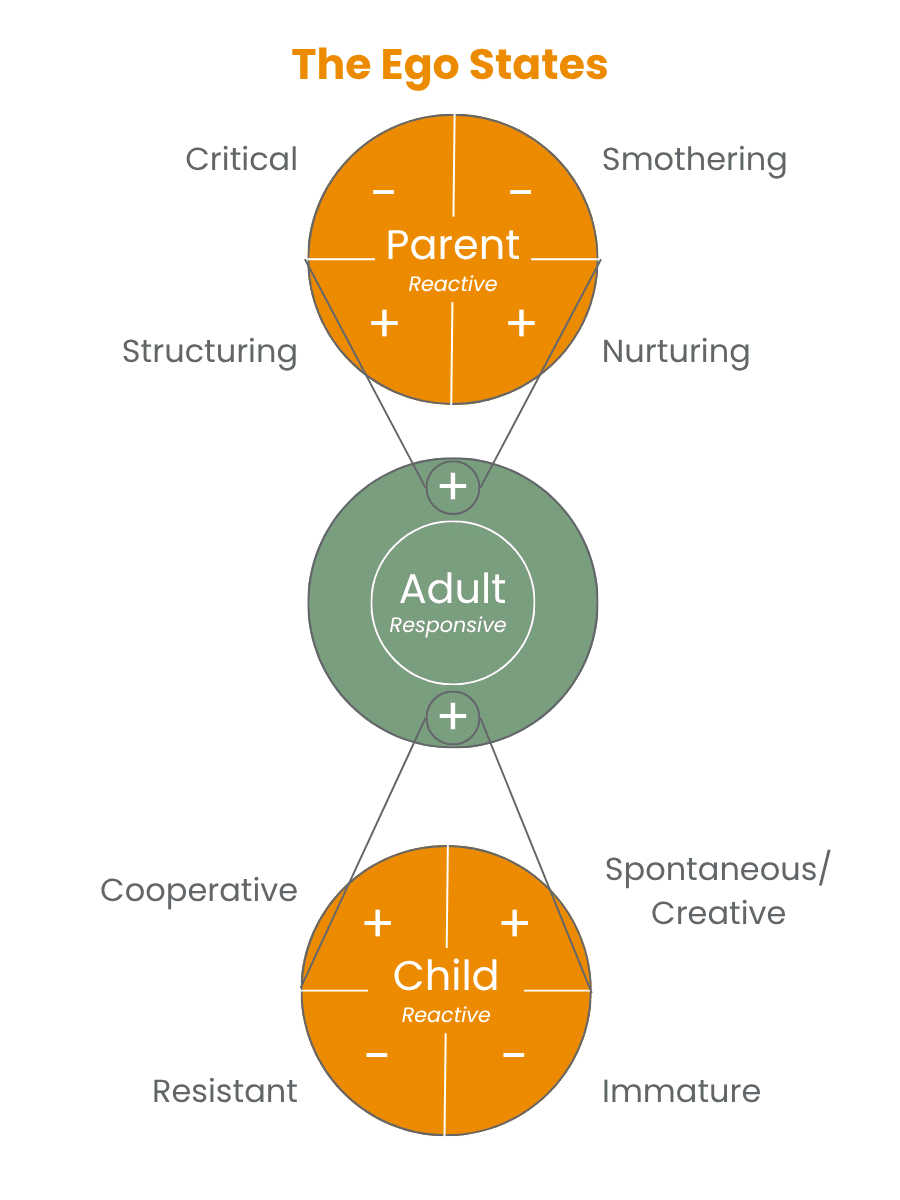
The Parent state draws on the attitudes, values, and behaviours we absorbed from authority figures growing up. When we’re in this state, we’re not responding freshly to what’s in front of us – we’re reacting from ingrained patterns. It has four functional forms, two negative and two positive.
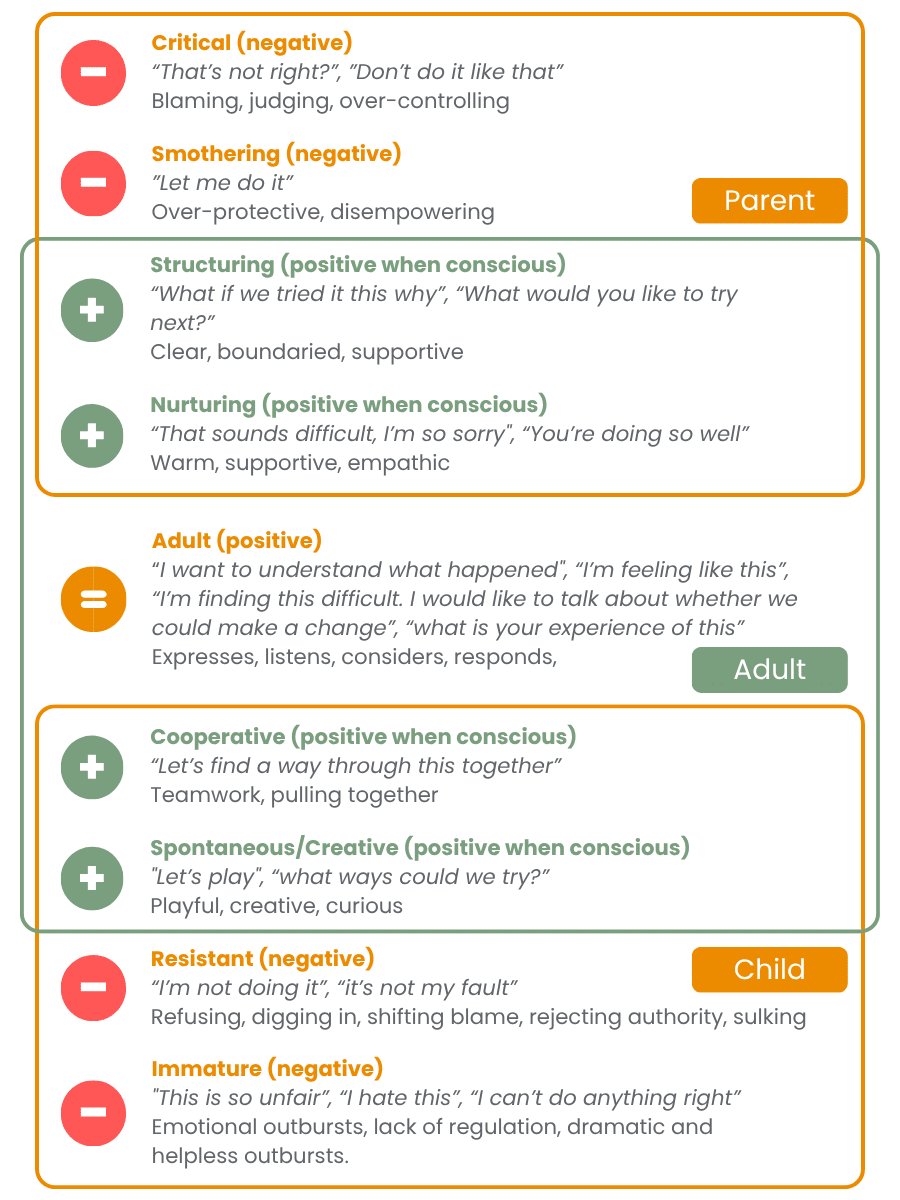
The negative side is probably the most recognisable. The Critical Parent is judgemental and blaming. This is the part of us that says things like “you always do this” or “why can’t you just get it right?”. The Smothering Parent disempowers by being over-protective, stepping in to fix things before someone has a chance to manage for themselves, or doing something so the other person doesn’t have to try.
The positive side of the Parent – Structuring and Nurturing – is genuinely useful. A Structuring Parent offers clear, boundaried guidance with a useful framework for growth and learning. A Nurturing Parent is warm, empathic, and supportive. Both provide unconditional care. But these only work well when they’re consciously chosen rather than reactive. More on that in a moment.
The Child
The Child state is one where we return to the behaviours, thoughts and feelings of childhood.
The negative Child states are the ones most likely to hijack a difficult conversation. The Resistant Child state involves rebelling against authority, shifting blame, trying to gain a sense of power, and a stubborn digging in of heels. It can be sulking and passive aggression – a rebellious withdrawing of cooperation essentially. The Immature Child state involves reacting emotionally and impulsively. It can be saying things we don’t mean, slamming doors, bursting into tears in a meeting. It is expressing raw, uncontrolled (and unregulated) emotion. It’s a tantrum—a demand for attention or emotional comforting, displaying a lack of impulse control to handle frustration.
The positive Child states are the Cooperative Child (flexible, willing to work together, genuinely open to finding a way through) and the Spontaneous Child (playful, creative, curious – the part that brings lightness and new ideas). Again, these are genuinely good qualities, but must be arrived at consciously.
The Adult
The Adult state is the part of us that responds to what’s actually happening, right now, clearly and calmly. Essentially it’s when we’re not being triggered -– there is no reaction from habit or history. It isn’t driven by old fears or the need to prove a point. The Adult is responsive rather than reactive. It is the place of communication, mediation, understanding, expression, even of the difficult things. It is the part of us that can say what we think in a constructive way, that can listen to the other person, that can find options for ways forwards and stay present, rather than flying off into reactive autopilot.
It is also where we can access the other positive traits of both the Child and Parent states, consciously and on our own terms.
This is the state we’re aiming for in all of our transactions, particularly difficult conversations.
A crucial distinction: reactive vs conscious access: From the Adult state, we can consciously draw on the qualities of the other states and when we do, those qualities are genuinely useful. We can be warm and caring (drawing on Nurturing Parent), clear and boundaried (Structuring Parent), playful and creative (Spontaneous Child), or genuinely collaborative (Cooperative Child). The difference is that we are choosing these qualities with awareness, rather than being thrown into them.
When we simply react into a state, even the ostensibly positive ones become problematic. A reactive Nurturing Parent can tip into smothering. A reactive Cooperative Child can become people-pleasing, agreeing with things we don’t actually agree with in order to smooth things over. What makes a state functional is not the state itself but whether we’re inhabiting it with intention.
Think of it this way: the Adult state isn’t neutral or flat. It’s the most fully human of the three, because it allows us to bring all of ourselves to a conversation – with awareness and intention, rather than on autopilot.
What Actually Happens When Two People Talk
In Transactional Analysis, every exchange between two people is called a transaction, and transactions fall into three types.
Complementary Transactions
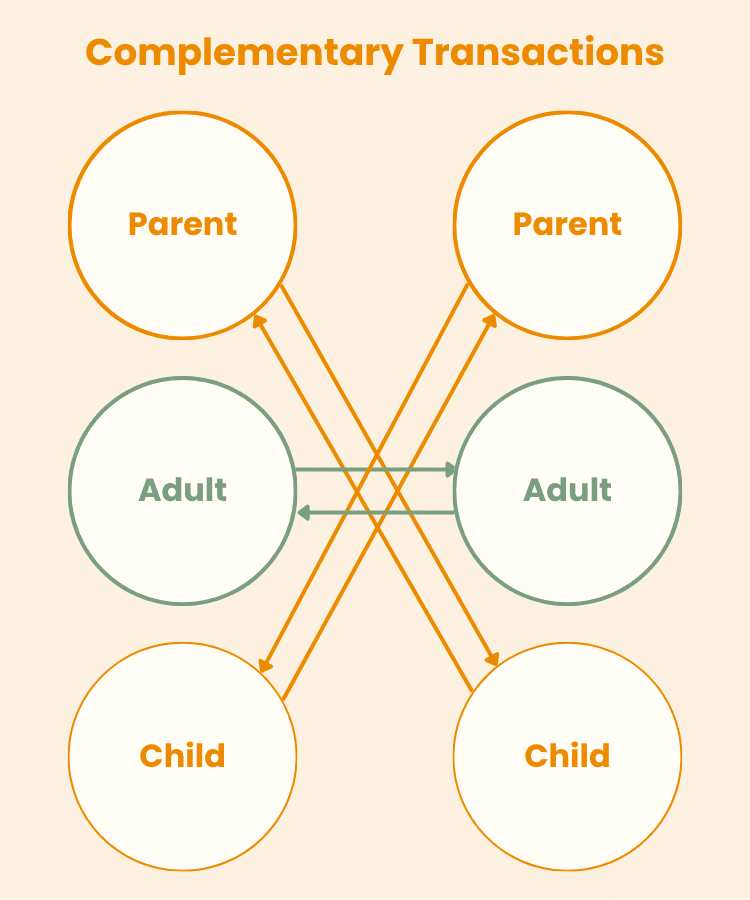
When the two people in a conversation are responding to each other from matching/expected states, the transaction is complementary – the communication lines run parallel. That doesn’t necessarily mean it’s pleasant or healthy. Two people locked in Critical Parent and Resistant Child respectively is a complementary transaction, and not an effective communication pattern.
At their best, complementary transactions are two people talking, each from their Adult state – genuinely listening, responding to what’s actually being said, calmly and consciously, working towards something together.
The key to complementary transactions is that it is what we’re naturally drawn to this type of transaction. They feel natural and can sustain indefinitely.
The reason this is so important is that it is how we can influence the way a conversation is going. If we hold an Immature Child state, i.e. low status, sulky, unable to engage productively, the other person will be encouraged into a Critical or Smothering Parent role. If we are in Critical Parent position (“don’t do it like that?”), we’re going to get an Immature or Resistant Child response (“you do it then!” [slammed door]).
Of course, this means that if we can find a way to find some calm and hold (or move towards) an Adult state, we can help transform an argument into a more productive discussion. The other person will feel drawn to come and meet us for an Adult to Adult complementary transaction.
Crossed Transactions
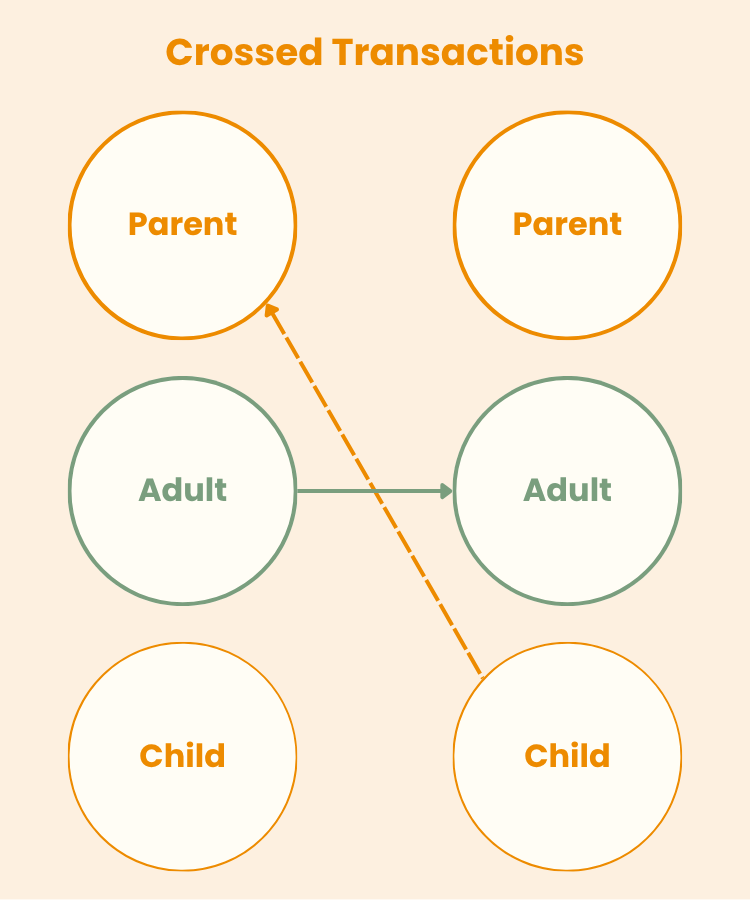
A crossed transaction happens when someone responds from a different state than the complementary one. If you ask a practical question from your Adult (“How did you get on with that task?”) and the other person responds as though you’ve attacked them (“I’m sick of being nagged!”), the lines on the diagram would cross. Crossed transactions feel jarring and uncomfortable. They interrupt the flow of communication.
This discomfort is why we tend to move into a Complementary transaction and we can use this knowledge to our advantage. We can cross a transaction to move to our Adult state, and that makes it much harder for the other person to stay in a reactive pattern. It may take more than one attempt. But they will either begin to join us in a more grounded (Adult) place, or they will leave the conversation. Either outcome is better than being locked in escalation.
Ulterior Transactions
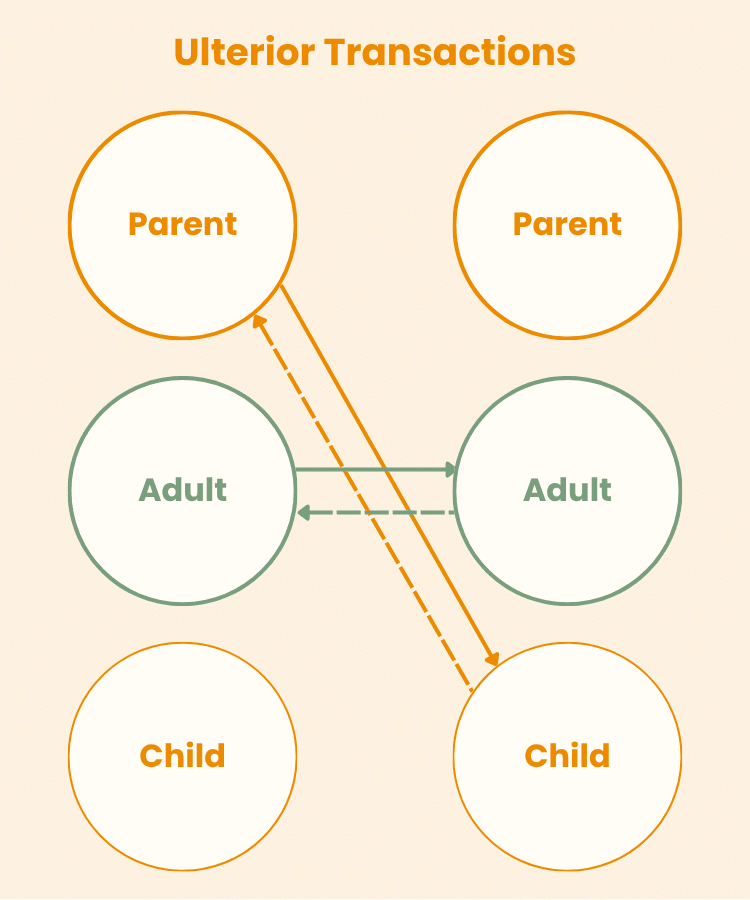
The third type of transaction is common, and worth being aware of. An ulterior transaction has two layers: what’s being said on the surface, and what’s really being communicated underneath. The surface message is called the social level; the real message is the psychological level.
Think of someone who says, with exaggerated politeness, “I’m sure you did your best” after something goes wrong. On the surface, it’s reassurance. Underneath, it’s a put-down. Or a partner who says “No, go out with your friends, I’ll be fine” in a tone that very clearly says the opposite. In ulterior transactions, the psychological message is the one that determines what actually happens next.
Becoming aware of when you’re receiving an ulterior message, rather than simply reacting to it, is one of the most useful things you can take from this model.
So Where to Start?
So where do you start? The simplest place is just to begin noticing. You don’t need to change anything yet – just start observing which state you’re in when conversations get difficult. Are you in Critical Parent, finding fault? Or Smothering Parent and refusing to delegate, empower, and release control? Perhaps it’s Resistant Child, going quiet or digging in? Or is that Immature Child bursting out all the time? Or are you managing to hold something calmer and clearer? Awareness always comes before change, and even a few days of simply paying attention can be really illuminating.
If you want to go further, try some emotional regulation. There’s loads of tips in my Mindful First Aid Kit and Senses blog which you can find here. Next time you feel yourself being pulled into a reactive state, pause before you respond. Take a breath or two and bring your focus to your body and to your immediate environment – notice a plant nearby or look carefully out the window.
And as you feel yourself become a little more present, ask what a more Adult response might look like. Something grounded, honest, and more likely to open the door to a balanced conversation. You won’t always manage it and that’s ok too – don’t get stuck in self blame and recrimination. A journal can be a get help with this too – if you can’t do it in the moment with another person, at first explore how you’d like to respond on paper. As with all this stuff, the more you practice, the more available it becomes.
Next time, I’ll be sharing lots more practical tools for having these difficult conversations. Sign up for my newsletter in the box at the footer of my website if you’d like to know when that’s available.
If this blog resonated with you, that recognition is often where real change begins. I work with people who are thoughtful and self-aware – people who understand themselves pretty well but find that insight alone doesn’t always shift things.
That’s where the work I do goes a little further. Alongside the psychological tools, support and exploration you’d expect from coaching, I draw on Polyvagal theory and somatic practice, which means we work with your body and non-conscious brain as well as your mind. It’s the difference between understanding why you do something and actually feeling safe enough to do it differently. Change that sticks, rather than change that requires gritted teeth and willpower (before running of out steam).
If you’re curious about what that might look like for you, a free exploratory chat is a good place to start – no commitment, just a conversation.